Parenting classes for toddler tantrums: a play therapist framework that can help with meltdowns
Your toddler's brain will not finish building the part responsible for impulse control until they are somewhere in their mid twenties. Not by next birthday. Not by kindergarten. Mid twenties. Which means that when your two year old drops to the floor of the cereal aisle because the box has the wrong cartoon on it, you are not watching a discipline failure. You are watching a brain that is doing exactly what an unfinished brain does.
That fact is either the most freeing thing you will read today or the most exhausting, depending on how your morning went. Most parents who start looking for parenting classes for toddlers are searching at 9pm, after a day that ended in a screaming match over a cup, with a knot in their stomach and a browser tab that says something like "is this normal."
So let us answer the real questions. What these classes actually teach, whether the free ones are enough, why this particular age wears you down more than any other, and what changes when the person teaching the class is a play therapist rather than an author with a podcast.
In case you are new here, I am Michelle Holdeman, founder of New Connections Mental Health. We are a team of child and family therapists who work with kids ages 3 to 17 and their caregivers, and we run a parent coaching program for families who are tired of feeling like referees. We spend our days with kids who cannot yet say what they mean and with parents who love them fiercely and are running on fumes. If that is your house right now, you are in very good company here.
Is there really a parenting class for toddlers?
Yes, and there are more of them than you would guess. The confusing part is that "parenting class" covers wildly different things. Some are court ordered co-parenting courses. Some are one hour hospital webinars on sleep. Some are structured, multi-week programs built on decades of child development research. They all show up in the same search results, which is why so many parents click three of them and give up. If you want the full landscape before you commit to anything, our guide to the different types of parenting classes lays out what each format is actually for.
The ones worth your time have a specific shape. They run over several weeks rather than a single afternoon, because a skill you hear about once is a tip, and a skill you practice for six weeks with feedback is actually yours. They are built around your relationship with your child, not around a list of consequences to deploy. And they assume you will get it wrong sometimes, which is a surprisingly rare feature.
Toddler parenting classes: what they actually teach
Parents often expect a class to hand them a script. Say this exact sentence, tantrum ends. What good toddler parenting classes teach instead is closer to a set of reflexes.
You learn to read what is underneath a behavior, so that hitting stops looking like defiance and starts looking like a child with no words for frustration and a body that acts before the thought arrives. You learn how to hold a limit without escalating, which is a physical skill as much as a verbal one, involving your tone, your height, your face, and how fast you are breathing. You learn what to do in the ninety seconds after you have already lost your temper, because that repair matters more than the outburst. And you learn how to play with your child in a specific, structured way that rebuilds connection faster than any conversation could.
Notice what is missing from that list. There is no chart. No jar of marbles. No new punishment system. Those things can have a place, but they are the trim, not the foundation, and most families who come to us have already tried them and found that they work for about nine days.
Free parenting classes for toddlers: what you get and what you don't
Free resources are genuinely good and we recommend them constantly. The CDC's toddler parenting materials, hospital-run webinars, library storytime programs with a parent education component, all of it is worth your evening. If money is the obstacle between you and support, start there tonight and do not feel one bit apologetic about it.
Here is the honest limit. Free classes are almost always one directional. They tell you what to do. They cannot see your specific child, hear the tone your voice takes at 6pm, or notice that the strategy you swear is not working is being applied about four seconds too late. They also cannot tell you the difference between a strategy that failed and a strategy that has not had enough weeks to work yet, which is the single most common reason parents abandon an approach that was about to help.
What you are paying for in a structured program is not better information. It is someone watching, adjusting, and telling you the truth about what they see. In our groups that is literal. Parents video their home play sessions and we watch them together, which means the feedback is about what actually happened in your living room on Tuesday, not about the tidy version anyone would describe from memory.
What is the hardest toddler age to parent?
Parents love to argue about this one. Two gets the bad reputation, but ask a room of parents and most of them will vote for three, with a loud minority insisting that three and a half is a distinct and unholy stage of its own.
There is a reason three feels harder than two. At two, your child has enormous feelings and almost no language, so the meltdowns are loud but they are simple. At three, language arrives. Now your child can tell you exactly what they want, argue about it, remember that you said no yesterday, and hold a grudge until bedtime. They have the vocabulary of a small negotiator and the emotional regulation of a wet paper bag. That gap between what they can say and what they can control is where the hardest year lives.
Why the hardest year is also the loneliest one
What makes it harder still is that everyone around you starts expecting more. A screaming two year old gets sympathetic looks. A screaming four year old gets opinions. So the age that is genuinely the most demanding is also the age where parents feel the most judged, which means you are managing your child's dysregulation and your own shame at the same time. That is not a fair fight, and it is a very common reason parents finally reach out.
In rural western Kansas that judgment has a particular flavor. Everyone knows everyone, the grocery store is not anonymous, and self-reliance is a regional value that quietly makes asking for help feel like an admission. Plenty of the parents in our groups joined from their kitchen table after bedtime, specifically because they did not want to have the conversation locally first. That is a completely reasonable way to start.
What is actually happening in a meltdown
It also helps to know what you are looking at while it happens, because a tantrum makes far more sense once you stop reading it as a performance aimed at you. We wrote a longer piece on what toddler meltdowns really mean and how to get through them without losing your own footing, and it is worth reading on a calm afternoon rather than mid-storm.

What do online parenting classes for toddlers look like when a play therapist runs them?
This is where the approach shifts. Most parenting curricula are written by educators and delivered as instruction. We come at it from a different direction, because our whole practice is built on the idea that play is a child's first language, and that a parent who learns to speak it gets access to their child in a way that talking never quite reaches.
Our parent groups draw heavily on Child Parent Relationship Training, a structured 10 week model where the parent, not the therapist, becomes the agent of change. You are not dropping your child off for someone else to fix. You are learning the core skills a play therapist uses in session and bringing them home, one skill per week, practiced in short play sessions rather than absorbed in one overwhelming download. Parents who have watched their child improve in play therapy often ask whether they could learn to do some of that themselves. The answer is yes, and that is largely what these groups are.
Meeting on a screen changes the logistics, not the substance. For a family an hour from the nearest clinic, a group that meets after the kids are in bed is the difference between getting support and getting none. What you lose is the shared plate of cookies. What you keep is the weekly rhythm, the practice assignments, the feedback, and the other parents in the squares next to you who are also having the cup-related meltdowns.
The play therapist framework: connection before correction
The framework itself is simple to state and hard to do. Before you correct, you connect. Before you teach, you regulate. Before you fix the behavior, you name the feeling driving it.
In practice that looks like getting physically low, matching your voice to a quieter register than the room, and naming what you see. "You wanted the blue cup. You are really mad." Then, only then, the limit. "The blue cup is in the dishwasher. You can have green or yellow."
Parents expect this to make tantrums disappear. It does not, at least not at first. What it does is shorten them, and more importantly, it changes what your child learns from them. A child who is met in their worst moment learns that big feelings do not cost them your love. A child who is punished for their worst moment learns to hide them.
The thirty minutes that changes the house
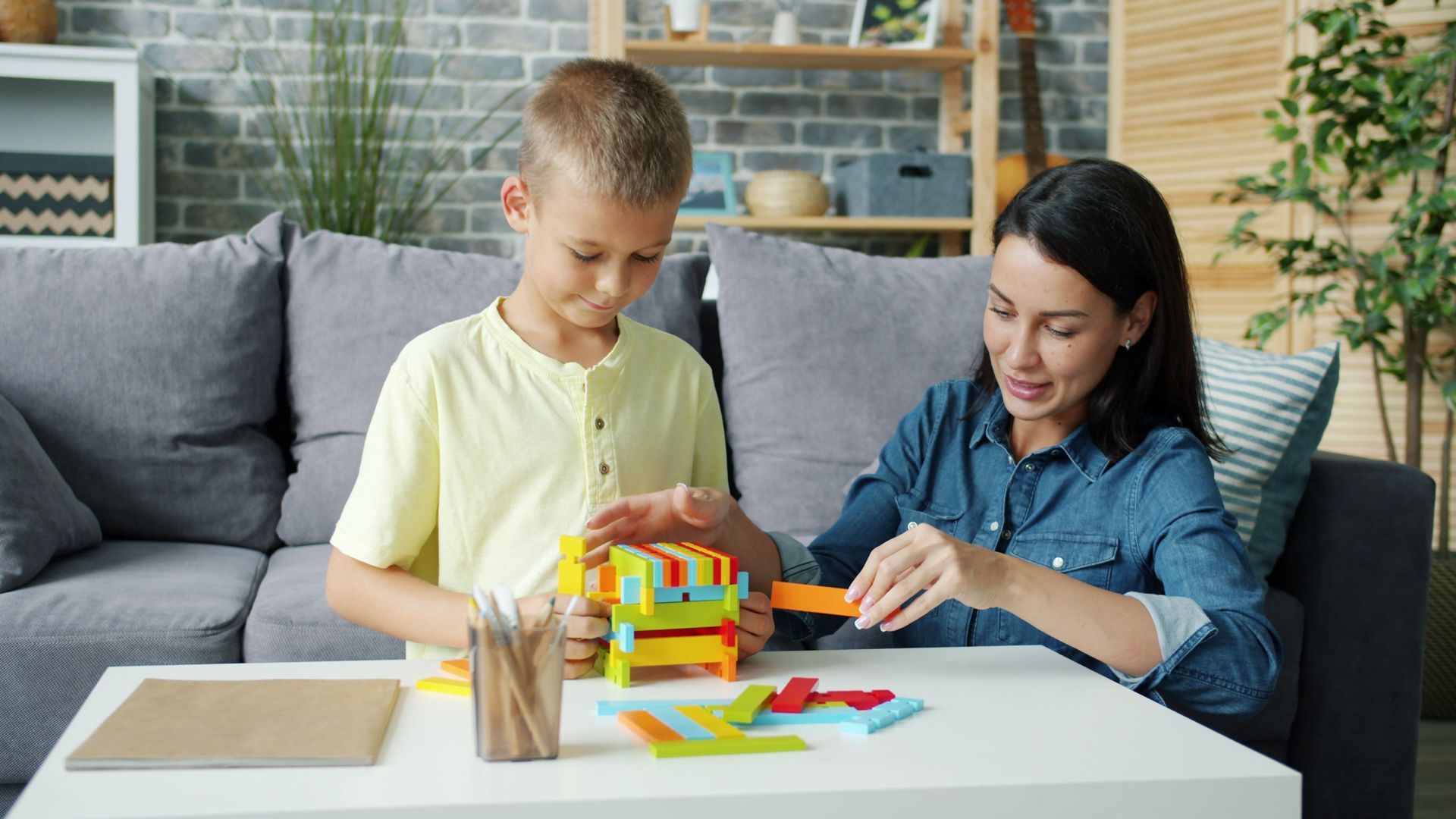
The other half of the framework is a weekly block of child-led play. Thirty minutes, no phone, no teaching, no questions, no correcting. Your child leads and you follow and narrate.
It sounds almost too small to matter. It is consistently the thing parents tell us changed their house. Part of why is that it is the only half hour in the week where your child is not being managed, corrected, hurried, or redirected, and toddlers notice that difference far faster than adults expect them to.
How do you discipline a 3 year old who doesn't listen?
First, a reframe that will save you some grief. A three year old who does not listen is usually a three year old who did hear you, understood you, and has decided that what they want is more compelling than what you want. That is not a hearing problem or a respect problem. It is a developmental stage in which testing the boundary is literally the work they are supposed to be doing.
What works is fewer instructions delivered more seriously. Most of us issue somewhere around forty directives before breakfast, which trains a child to filter. Cut the number down. Save the firm voice for the ones that actually matter, and let the rest go. Get physically close before you speak instead of shouting from another room. Give the instruction once, wait a beat longer than feels natural, and then follow through with your body rather than repeating yourself louder.
Follow through is the part that collapses in most homes, and not because parents are inconsistent by nature. It collapses because we are tired, because we are in public, because a tantrum right now would be catastrophic for the schedule. That is human. It is also why a class helps more than an article, since what you need is not the concept but a plan for the five specific moments each week where you know you will cave.
Strong willed toddlers: why the usual consequences stop working
Strong willed children are not broken and they are not spoiled. They are wired with an unusually high need for autonomy, and a consequence that takes away their control tends to increase the very resistance you were trying to reduce. You take the toy, they escalate. You add a timeout, they escalate. You hold firmer, they hold firmer, and by minute twenty you are negotiating with someone who has more stamina than you and no meetings tomorrow.
What works with these kids is giving control back in places where it is safe to give it. Not fake choices that insult their intelligence, but real ones. Which shoes, which order, which route, how many. They need to spend their autonomy somewhere. If you offer them nowhere, they will spend it on the thing you least want.
It also helps to remember what this trait becomes. The three year old who will not be moved is, if we do this well, the fifteen year old who will not be pressured. That is worth some hard afternoons.
What is a red flag behavior for a 2 year old?
Most of what worries parents about toddlers is squarely normal. Hitting, biting, throwing, screaming, the sudden refusal to wear anything with a seam. Ugly to live with, developmentally ordinary.
The things that are worth a professional conversation are less about intensity and more about pattern. The ones we ask about most often:
- A near total absence of pointing, showing, or bringing you things to look at by around eighteen months to two years
- A loss of words or skills your child clearly had before
- Almost no pretend play by three
- Tantrums that regularly run far past the twenty minute mark, or that involve your child hurting themselves
- Behavior that changed sharply after a specific event, such as a move, a loss, a hospital stay, or a frightening moment
- A child who seems flat, who does not seek comfort from you when hurt, or who cannot be soothed by anyone
None of these are diagnoses and none of them mean something is wrong. They mean the question deserves a real answer from someone who does this for a living, rather than another hour of searching at midnight. Bringing a concern early costs you one appointment. Waiting because you are afraid of overreacting costs you months of worrying alone.
I yell at my toddler every day. Is this normal?
Yes. And also, we know you did not really want a yes, you wanted permission to stop feeling like the worst person in your house.
So here is the fuller answer. Yelling at a toddler is extremely common and it does not make you an unsafe parent. It is also usually a symptom rather than a character flaw. Parents yell when they are depleted, when the day has had no margin in it, when the same behavior has repeated eleven times, and when nothing else has produced any result. Aiming willpower at the yelling almost never works, because willpower is exactly the resource that has run out by the time you yell.
Change the conditions, not the resolve
What does work is changing what surrounds the moment. Reducing the number of daily flashpoints, most of which cluster into about three predictable windows: morning, the hour before dinner, and bedtime. Building in the one break you swore you did not have time for. Learning the physical cues that arrive about forty seconds before you snap, a tightening jaw, heat in the face, a held breath, and having one specific rehearsed move for those forty seconds rather than five you will never remember.
And repairing afterward, out loud, every time. "I yelled. That was not okay, and it was not about you. I am sorry." Then stop, without attaching "but if you had listened," which turns an apology into a second lecture. That one sentence teaches your child more about emotional regulation than a calm week would.
If the yelling has become daily and it is starting to change how your child looks at you, that is not a reason for shame. It is a reason to get support, and it is one of the most common things parents say in their first session with us.
What would bedtime feel like if the meltdown wasn't waiting at the end of it?
You are not doing this badly. You are doing one of the genuinely hardest stages of parenting with very little training, usually while tired, often while being watched. The fact that you are reading about parenting classes for toddlers at all says something good about you, not something worrying.
At New Connections Mental Health, we help parents of little ones stop white-knuckling the day and start understanding what their child is actually communicating.
We see families across western Kansas online, including our parenting classes in Hays, KS and the families who join us from Great Bend and Barton County.

Hi! I'm Michelle Holdeman
Licensed clinical social worker and founder of our group therapy practice for kids and teens
I help overwhelmed parents, sensitive kids, and emotionally intense teens move from daily meltdowns to deeper connection—using play-based, trauma-informed therapy that truly works. At New Connections Mental Health, we create space for healing, growth, and lasting change—one session, one family, one feeling at a time.